
Howdy, Ryan

If you are reading this, then you probably already know that Panama is widely one of the best retirement destinations in Latin America. And when it comes to Panama residency, the Panama retirement visa (the “Pensionado Visa“) is one of the best options for foreigners fortunate enough to qualify.
Not only does the Pensionado Visa provide a coveted direct path to permanent residency, but it also offers a range of benefits and discounts. And it remains one of the most affordable residency programs currently available in Panama.
The basic requirements are pretty easy to find online. In fact, they are repeated again (and again, and again) on immigration websites, relocation forums, and on social media.
On the surface, it all appears pretty black and white.
But knowing the basic requirements and understanding how they actually apply are two different things.
Because real immigration applications involve real people with different sources of income, spouses, children, investments, and documents issued by foreign governments and entities.
And that’s where things get interesting.
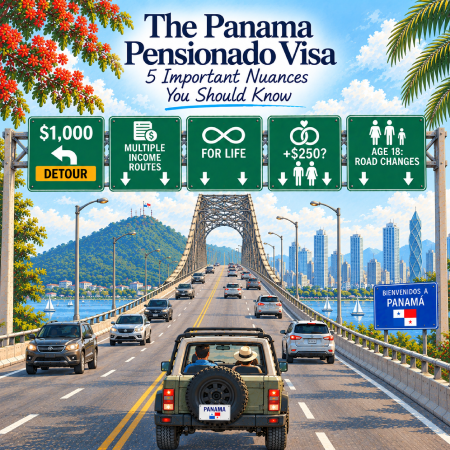
So, in this article, we’re going to look beyond the basic requirements and explore a few of the peculiar nuances of Panama’s Pensionado Visa. For some would-be applicants, these little quirks might be the difference between qualifying for the Pensionado Visa, or not.
The Main Requirements for the Pensionado Visa
As numerous Panama immigration lawyers’ websites will tell you, there are basically two main requirements to qualify for the Pensionado Visa:
- The applicant must be the beneficiary of a pension, retirement, or similar plan paying a minimum of $1,000 USD per month; and
- The plan must provide a lifetime benefit.
If you receive a benefit in a different currency, then it should be the equivalent to at least $1,000 USD.
And if you are applying with a spouse or other dependent(s), the minimum monthly income generally increases by $250 USD for each dependent included in the application.
Straightforward enough, right?
But here are a few additional things you should know.
Nuance #1: You Don’t Always Need $1,000 USD Per Month
This one seems particularly straightforward. You either receive the requisite $1,000 USD per month, or you don’t.
Except there is an interesting exception.
If you have purchased a real estate property in Panama for at least $100,000 USD, then you may qualify for the Pensionado Visa based on a lifetime pension, retirement, or similar benefit of just $750 USD per month.
So, let’s say you are receiving a net social security benefit of just $900 USD per month. On its own, that would fall below the normal $1,000 USD threshold.
One option would be to just wait and hope that the annual cost-of-living adjustments (COLA) eventually put you over threshold.
But if you already own (or if you intend to purchase) a qualifying real estate in Panama, the reduced $750 USD threshold may provide another path to permanent residency based on your existing benefit.
This is a relatively obscure exception. But for the right applicant, it can make a big difference.
Nuance #2: Stacking Different Types of Qualifying Income
Most people tend to think of the Pensionado Visa in terms of a traditional employer pension, military retirement or or something like Social Security.
But the legislation is actually broader than that. It also contemplates income from a lifetime annuity product from a private insurance company.
For example, let’s say you purchased an annuity from a private insurance provider that contractually guarantees payments of $1,250 per month for the rest of your life. Depending on the specific terms of the product and the supporting documentation, that income may satisfy the Pensionado Visa requirements.
To be clear, an annuity that allows the client to withdraw invested cash would NOT satisfy the lifetime benefit requirement. However, an annuity that pays a fixed minimum return above the threshold and in which the client and company are locked in for life WOULD meet the requirements for the Pensionado Visa.
It may also be possible to combine qualifying benefits.
For example, suppose you receive a VA disability benefit benefit of $600 USD per month, together with $415 USD per month from a qualifying lifetime annuity. The combined $1,015 USD monthly benefit could put you above the Pensionado Visa threshold.
The important part here is the lifetime component.
An annuity that allows you to withdraw your own invested capital is not the same thing as a contractual lifetime benefit. Here, the specific terms of the product and the documentation from the provider matter. Read more about applying for the Pensionado Visa based on a lifetime annuity from an insurance company.
Similarly, distributions from a consistently high performing investment account will usually not qualify to the extent that the benefit are tied to the market.
And if you are applying for the Pensionado Visa based on benefits from any private provider, there will usually be some additional documentation that you’ll need to gather and prepare for the application package.
This is one of those areas where the basic $1,000 USD per month rule doesn’t necessarily tell the whole story.
Nuance #3: What if Your Benefits Letter Doesn’t Say “Lifetime“?
This one comes up all the time.
To you, it may seem obvious that your Social Security benefit, Canada Pension Plan (CPP), Veterans Affairs (VA) benefit, or Old Age Security (OAS) payment is payable for the rest of your life.
But the Panamanian immigration officer reviewing a benefit issued by a foreign government cannot necessarily assume how another country’s pension system works.
Ideally, your benefit letter will explicity state that the payment is a “lifetime benefit”, or that it is payable “for life” or “for the lifetime of the beneficiary”, or some similar variation language.
But more often than you might expect, that detail s missing.
Fortunately, that doesn’t necessarily mean you have a problem.
In many cases, we can prepare a simple one-page affidavit in which the applicant swears that the Social Security, Veterans Affairs, CPP, OAS, or other qualifying payment constitutes a lifetime benefits.
The affidavit is then notarized and apostilled, or authenticated by a Panama Consulate, along with the other foreign documents being prepared for the residency application.
For US applicants, it may also be possible to execute an appropriate affidavit through the US Embassy in Panama.
The point is that if your benefits letter doesn’t contain the exact language Immigration wants to see, don’t automatically assume that you don’t qualify. There may be a relatively simple way to address it.
Nuance #4: Applying with a Spouse Can Get Interesting
As we mentioned earlier, the Pensionado Visa generally requires that the primary applicant is receiving an additional $250 USD for each dependent family member included in the application.
So, let’s say you have a Social Security benefit of $1,100 USD per month. That’s enough for you. But if your spouse wants to apply as your dependent, you’re $150 USD short of the normal $1,250 USD threshold.
That’s obviously not ideal if the plan is for both of you to relocate to Panama together.
Fortunately, there are a couple of possibilities worth understanding:
Combining Lifetime Benefits
First, if your spouse also receives a lifetime pension or annuity benefit, the law allows a married couple to combine their benefits satisfy the minimum monthly threshold.
And here is where things get a little strange.
If a married couple applies based on just one person’s benefit, then the threshold is bumped up to $1,250 USD per month. But if the spouses combines qualifying benefits, then the threshold remains at $1,000 USD per month.
For example, let’s say you receive $700 USD per month from Social Security, and your spouse receives $350 USD per month from a qualifying lifetime pension.
Your combined benefit of $1,050 USD per month may allow the two of you to qualify for the Pensionado Visa as a married couple.
It may seem counterintuitive, but this is one of those little nuances that can completely change the analysis for a particular family.
Demonstrate Economic Solvency through a Panama Bank Account
There is another potential solution to the additional $250 USD per month dependent-income requirement.
The primary applicant may be ablet o demonstrate sufficient economic solvency by producing a reference letter from a local bank saying that he/she maintains at least $5,000 USD in a local bank account.
There is at least some logic behind this exception.
The additional $250 USD requirements is intended to demonstrate that the primary applicant has sufficient economic resources to support a dependent. Maintaining sufficient funds in a local bank account provides another way to demonstate that solvency.
So, depending on the circumstances, a couple with qualifying lifetime benefits slightly above $1,000 USD per month may still have a paty to applying together.
Nuance #5: Be Careful When Applying with Dependent Children
The Pensionado Visa allows you to apply for residency for your minor children. But for retirees with dependent children over the age of 18, the pathway to permanent residency is a little tricky.
If your young adult (over 18) child applies for the Pensionado Visa with you, you’ll need to demonstrate more than just the parent-child relationship. Among other requirements, you’ll generally need to show that the child is not married. And you’ll need to prove that he/she remains a full-time student so that he/she can still qualify as your dependent.
Those are important details to consider. But not insurmountable for many families whose over-18 children are still reliant on their parents.
But there’s another important limitation: your child’s residency as a Pensionado Visa dependent generally only extends until age 25. We wrote about this in more detail in a recent article explaining why some clients may choose a different visa such as the Friendly Nations Visa over the Pensionado Visa.
That’s obviously not ideal for a family hoping to obtain permanent residency together. But there may be another strategy.
Instead of including the adult child as an applicant in the initial Pensionado Visa application, the parents can first apply for the Pensionado Visa just for themselves. That application will usually be processed in less than 6 months.
Then, once the parents’ permanent residency is approved, the adult son or daughter may be able to apply under the residency category for a “Dependent of a Permanent Resident“.
The child will still need to satisfy the applicable dependency requirements, including documentation to prove that he/she is a full-time student. But rather than receiving residency only until age 25 under the Pensionado Visa category, this strategy can provide an initial 2-year residency with a subsequent path to permanent residency.
Based on the current rules, this strategy can potentially be used until the dependent son or daughter reaches 25 eyears of age.
For families with older dependent children, this is an excellent example of why choosing how to apply can be just as important as determining whether you’ll qualify in the first place.
Bottom line?
The basic requirements of Panama’s Pensionado Visa are easy to find.
But as you can see, there are quite a few ways those requirements can play out differently, depending on your income, your spouse, your children, your investments, and even the way your benefits are structured.
And that’s really the point.
Immigration law rarely gets complicated because of the basic rules. It gets complicated when you start applying that rule to real life.
So, if you appear to fall just outside of one of the Pensionado Visa requirements, don’t automatically assume that you cannot qualify. There may be another way to structure hte application, or another residency program that makes more sense for you and your family.
Do you have questions about whether the Panama Pensioner Visa can work for you? Send us an email at info@theindependentlawyer.com, or fill out a Contact Form on our website.
Let’s explore this together.