
The Friendly Nations Visa (the “FNV”) and the Retirement and Pensioner Visa (the “Pensionado Visa”) are two of the most popular paths to residency among our clients.
But what about when a client qualifies for both?
It’s a good problem to have. And while both programs have their advantages, the Pensionado Visa is usually the clear winner. Usually — but not always!
In this article, we’ll compare the Panama Friendly Nations Visa vs. the Pensionado Visa, including costs, documentation, residency status, work permits and the rules for dependent children.
Who Qualifies?
We’ll start with this one, because eligibility is kind of a threshold question.
Not everyone can even apply for the FNV. To even submit the application, the primary applicant must have a passport from one of a list of 50 countries that have been deemed “friendly” to Panama.
Of course, assuming your passport makes you eligible to apply, you’ll still need to satisfy the other requirements to qualify for the FNV. But if you don’t have a passport from a country that is on the list, then there is no reason to even consider the FNV.
You can check whether the country that issued your passport qualifies on our website.
Meanwhile, the Pensionado Visa is not restricted to specific passport holders. Anyone who otherwise meets the criteria (and who can get to Panama to submit the application) can apply.
Which Visa Costs Less?
First and foremost, the Pensionado Visa application process is less expensive than the FNV.
I am not talking about legal fees, because our fees are similar for both. I am talking about third-party expenses associated with the application process. These are things like translations of your foreign documents, notarizations of your signatures, registration of your passport, payments to the Panama government (if applicable), the multi-entry and exit visa, and the little residency ID cards.
Here is a comparative breakdown of the current approximate third-party expenses related to a standard initial FNV application for 1 person vs. the Pensionado Visa application for 1 person:
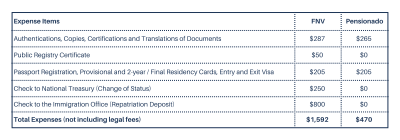
As you can see, the big difference is that for the FNV you need to issue a certified check for $250 to Panama’s National Treasury for each applicant + another certified check for $850 to the Immigration Office for each applicant over 12 years old. Actually, most Panama visa applications require these payments.
But these payments are waived for the Pensionado Visa. This makes the Pensionado Visa one of the most cost-effective visa applications that Panama offers.
Which Requires More Documentation?
The requirements for the Pensionado Visa are also usually simpler and require less of the applicant. You can read about them HERE in more detail, but there are basically just 2 main requirements:
- The applicant must be the beneficiary of a pension or annuity that pays at least $1,000 per month; and
- The pension or annuity must provide a lifetime benefit.
These requirements are pretty straightforward, and in most cases we can quickly and easily predict whether your benefits will qualify for the Pensionado Visa.
One exception is when you are applying based on benefits from a private pension provider or insurance company. In that case, you’ll need some additional documentation showing that the company is a legitimate, licensed and regulated provider. You’ll also generally need bank statements showing the monthly benefit being deposited into your account.
This is still pretty straightforward in most cases, although the paperwork can become a little more complicated when a third-party administrator or intermediary is involved.
Meanwhile, the requirements for the FNV are just a bit more complicated and involved.
- First, the applicant must have a passport from one of a list of 50 countries that have been deemed “friendly” to Panama.
That is easy enough. You can even check the list on our website. - The applicant must also demonstrate either:
a.) a promissory work letter from a Panamanian corporation with a business license; or
b.) a qualifying investment of at least US$ 200,000 in real estate property, or in a minimum 3-year time deposit (a “CD”) with a local bank.
To be clear, a qualifying investment must be completed before applying for residency. A lot of folks would rather move to Panama and take their time to get in tune with the market before making such an investment.
In any case, we can see that the Friendly Nations Visa requires you to do some things in Panama before submitting the residency application. In contrast, you can generally prepare everything you need for the Pensionado Visa application in your home country before you arrive.
Comparing the Application Process
Once all the documents going into the applications are ready, the application processes for the Pensionado Visa and the FNV are pretty similar. For both programs, we’ll ask you to plan to be in Panama for at least 5 business days. During that trip, you’ll receive a provisional residency card that allows you to remain in Panama (and to come and go as you please) during the up to 6 months that it could take for your long-term residency to be approved.
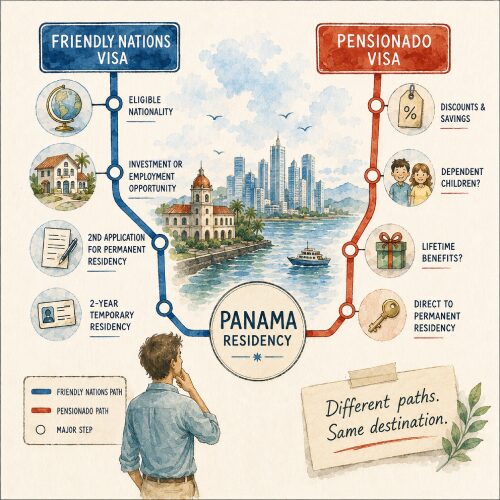
But here is where the two application processes differ. The Pensionado Visa offers a direct path to permanent residency, while the FNV makes you initially apply for a 2-year residency that can then be renewed for permanent residency as long as the applicant still meets the requirements.
The direct path to permanent residency is what really makes the Pensionado Visa truly exceptional. In fact, it is one of the few residency visas that still offers a direct path to permanent residency in Panama without a major investment.
Because the FNV involves a second application to obtain permanent residency, you’ll eventually need to go through another round of paperwor, legal fees and immigration processing.
But the good news is that the expenses of the FNV application are substantially lower the second time around when you apply to renew your visa for permanent residency.
When the FNV may be a Better Option
As I said, the Pensionado visa is usually (but not always) the preferred option for a client fortunate enough to qualify for both visa programs. There area couple of scenarios when the FNV may be better suited to a client’s needs.
Scenario 1
The first scenario is when the client or the client’s spouse plans to work in Panama.
You see, Panama immigration law has a bit of an ambiguity. On one hand, Article 7 of Law Decree No. 6 (April 13, 2023) says that once a person has permanent residency, that person can apply for a work permit. But then there is an exception that appears in Article 6 of Law 9 (June 24, 1987) that prohibits someone who has obtained residency via the Pensionado Visa from obtaining a work permit.
The limitation on Pensionado Visa holders sort of makes sense as a policy matter to the extent that the Pensionado Visa is intended to provide residency to people who are “retired” and living on a fixed income. But it is pretty annoying, because some would-be Pensionado residents would undoubtedly love to take on a job to stay active, supplement their fixed pension income and contribute to the greater Panama economy.
In any case, you should be aware that the current interpretation is the Pensionado Visa does not allow qualifying applicants to apply for a work permit. But the FNV does!
Scenario 2
The second scenario is when a client wishes to apply with dependent minor children. Here, the Pensionado Visa has a very specific limitation. With very limited exceptions, the Pensionado Visa only allows you to obtain residency for your dependent children until age-25.
Now, we see two schools of thought here. A lot of people say,
“Hey, who knows whether my kids will have any interest in Panama when they are 25 years old?”
Other people say,
“Yeah, who knows? But in a fast-changing world, we’d like to give my children the gift of a second residency that they can carry with them for the rest of their lives, and they can decide when and whether they want to use it.”
If you fall into that latter camp, then you have a couple of options. For one thing, you could apply for the Pensionado Visa for yourself, initially. Within 6 months, you’ll be a permanent resident. And then you could have your dependent children apply for residency via a program called the Dependent of a Permanent Resident Visa.
Just like the FNV, the Dependent of a Permanent Resident Visa also initially grants a 2-year residency, which can then be renewed for permanent residency.
Or, your family could all just apply for the FNV together to obtain your 2-year residency, and then your permanent residency, at the same time.
The nuances of applying for residency with dependent children are an interesting topic. There are actually some practical reasons that many people specifically decide NOT to apply for residency for their minor children (or at least to delay the kids’ residency).
And the decision matrix gets even more interesting if your son or daughter is over 18, but still your dependent. If this applies to your family, then you can read more about that topic HERE.
What about the Pensionado Discounts?
I almost forgot to touch on this topic. The Pensionado Visa offers a bunch of very attractive discounts and benefits. And this is actually one of the main drivers for many people who choose to apply for Panama’s Pensionado Visa.
But there is one detail that a lot of people don’t know. Once you are a permanent resident of Panama and over retirement age, you’ll be able to take advantage of the discounts at restaurants, movie theaters, and hotels anyway!
The retirement age is currently set at 55 for women, and 60 for men. So, once you reach that age, you’ll be able to ask for the discount on your lunch bill no matter how you got to permanent residency.
Bottom Line?
The Friendly Nations Visa (“FNV”) and the Retirement and Pensioner Visa (“Pensionado Visa”) are two of the most attractive residency options that Panama offers. And our office processes both of these visa applications many times every single month.
If you are fortunate enough to qualify for both, then the Pensionado Visa is generally the recommended residency option. It is one of the least expensive visa options, it doesn’t require a major investment prior to applying, and it provides you and your spouse a direct path to permanent residency.
But keep in mind the fact that the Pensionado Visa does not allow qualifying applicants to apply for a work permit. Also, if you are trying to get residency for your son or daughter, then there are some special considerations to keep in mind. And we are very happy to help you navigate those options.
If you have questions about how this might apply to your family, then I would love to hear from you. You can write to me at info@theindependentlawyer.com, or just fill out a CONTACT FORM on our website.