

If you’re applying for residency in Panama, then your homework really begins with the gathering of documents from outside of Panama.
Here are some of the documents you may need to prepare:
- Each applicant is definitely going to need a passport with at least 6 months of remaining validity at the time you submit the residency application.
- Each applicant over 18 years old is going to need a national-level police report (such as an FBI report from the United States).
- If you are applying as a dependent spouse, then you’ll require a freshly issued certified copy of your marriage certificate.
- You’ll need birth certificates for your kids, and possibly a copy of your own birth certificate if applying with an elderly parent.
- Pensioners will need documentation to support their qualifying pension or retirement program(s).
- In some cases, and for certain visas, you may also need a death certificate, court order, medical diagnosis, an authorization letter, or certification of enrollment in university.
Now, before you bring these documents down to Panama, you are going to have to take some additional steps to certify these documents in a way that they can be accepted internationally.
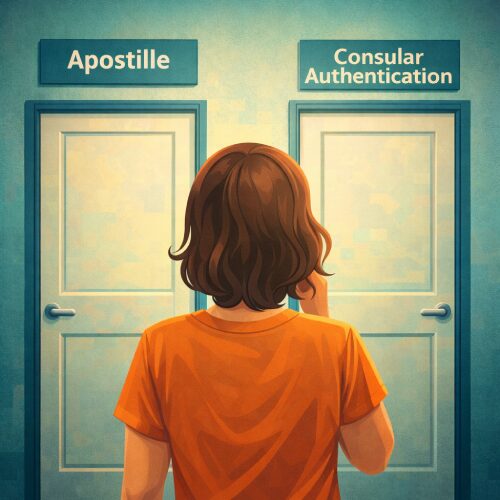
And this is where the apostille and the Consular authentication come into play.
Apostille vs. Consular Authentication
Apart from your passport, pretty much any document you bring from outside of Panama for your residency application is going to require either an apostille by the government of issuance or an authentication by the Panama Consulate in the government of issuance (the “Consular authentication”).
To be clear, it’s one or the other. No document needs both an apostille and a Consular authentication.
And for our purposes, one is pretty much just as good as the other. Both serve the same purpose, which is to tell the immigration officer in Panama that your documents are legitimate versions of what they appear to be.
And this actually makes a lot of sense.
Think about it. Each day, the immigration officer in Panama is receiving documents from numerous different countries — the United States, Canada, France, Israel, China, Singapore. The immigration office receives police reports, marriage certificates, birth certificates, etc from all over the world.
And they all look very official and important. So, how is the immigration officer to know that they are true and correct documents?
This is the purpose of the apostille. This is how the government of the country where the document was issued tells the Panama immigration officer that these are legitimate documents.
This is also the purpose of the Consular authentication, which is basically the Panama consulate saying the same thing:
We are the Panama Consulate in [insert Country], so we know what a [insert police report, marriage certificate, birth certificate, etc] from that country looks like. And we are telling you that these docs are legit!
If you’re interested in learning more about the apostille, then you might enjoy an article we wrote several years ago: WTF is an Apostille?!?
Our Preference for the Consular Authentication in the United States
If you are coming from a relatively small country, then obtaining an apostille is probably a pretty straightforward, fast, and easy process. But if you are coming from a larger country like the United States, then your documents may require an apostille from multiple different federal and state-level government offices.
For example, a federal document, such as an FBI report would generally be sent to the US Department of State in Washington, DC for an apostille. Meanwhile, a state-issued document, such as a birth certificate or a marriage certificate, would generally fall within the jurisdiction of the Secretary of State or similar office in the particular state where the document was issued.
This is why we usually recommend that clients send their US documents for Consular authentication rather than an apostille. Working with one of 8 Panama Consulate offices located around the United States usually makes for an easier and more straightforward process.
Here are a couple examples of what I mean:
Example 1
For example, let’s say you and your wife were married in Washington state, where you had your first child. But you now live in California, where you had your second child. If you plan to obtain apostilles for all of your documents or your, then you’re going to have to deal with multiple different government offices:
- You and your wife’s FBI reports will need to be sent to the US Department of States;
- Your marriage certificate and first child’s birth certificate will both require an apostille from the Washington Secretary of State; and
- Your second child’s birth certificate will need an apostille from the California Secretary of State.
Alternatively, you could have just send all 5 of those documents to the Panama Consulate in Long Beach, California to be authenticated all at once and in just one place. That’s because the Panama Consulate in Long Beach, California can authenticate documents from the entire West Coast, including both California and Washington state. And all of the Panama Consulate offices can authenticate federal documents, like you and your wife’s FBI reports.
But that is a relatively straight-forward case. Now let’s consider an even more complex situation.
Example 2
Let’s assume you are applying for the Pensionado Visa with your wife and minor child. You were married in California, but your child was born in Texas. You plan to qualify based on a state pension from New York, which is where you lived for years. Now, you are living in Florida. If you plan to obtain apostilles for all of your documents, then you’re going to have to deal with multiple different government offices:
- You and your wife’s FBI reports will need to be sent to the US Department of States;
- Your marriage certificate will require an apostille from the California Secretary of State;
- Your kid’s birth certificate will require an apostille by the Texas Secretary of State; and
- Your state pension documents are probably going to need an apostille by the New York Department of State.
That’s going to be a big pain — especially to manage from Florida!
Each of these government offices is going to offer different costs and turn-around times. And they may have different policies as to how they want you to submit your documents. You might consider contracting a third-party company just to help you manage the whole process.
Alternatively, you could just send all 5 of these documents to the Panama Consulate in Washington, DC. That’s because they can authenticate documents from all 50 states, when accompanied by federal documents like you and your wife’s FBI reports.
If you want to read more about our preference for the Consular authentication in the United States, then check out this article we posted last year: How to Get an Apostille in the US (and Why you Probably Shouldn’t).
Pros and Cons of the Consular Authentication
All of that being said, there some downsides to sending your documents to the Panama Consulate for authentication. Here is an honest look at some things we like about the Consular authentication option, as well as some potential headaches to keep in mind.
What we Love about the Consular Authentication
1. The Panama Consulate offices are small.
That may not sound like a big deal, but in practice it often means you are dealing with:
– fewer layers of bureaucracy;
– fewer departments; and
– fewer people involved in processing your documents
In many cases, this makes the process feel a bit more human.
You’re not just submitting documents into a large system — you’re dealing with a smaller team that handles these requests every day.
2. The experience with the Panama Consulate is mostly consistent and, therefore, predictable.
Once you understand how a particular consulate operates, the process is usually consistent and repeatable.
There are established procedures, standard fees, and a relatively straightforward workflow. Your Panama attorney can probably provide fairly precise guidance as to which documents require an affidavit or notarization, how to package the documents, and how much the process is going to cost.
There usually aren’t many surprises once you get into the rhythm of it, which allows our office to provide better and more precise guidance.
And if there are surprises or issues, then you can likely work with a real person with the authority and interest to try to help you work through the situation, because — as we noted — the Panama Consulate offices tend to be quite small and personal.
3. All documents can usually be authenticated in just one place (and I’ll emphasize USUALLY one more time).
This is probably the biggest advantage.
In many cases — especially for clients coming from the United States — you can send all of your documents to a single Panama Consulate for authentication.
That includes:
– federal documents (like FBI reports);
– state-issued documents (like birth and marriage certificates); and
– notarized documents (like affidavits)
Compare that to the apostille process, where you may need to deal with multiple different government offices depending on where each document was issued.
If you plan it correctly, consular authentication can feel like a one-stop shop.
Now, as much as we like the consular authentication route, it is not perfect. Here are a few things that can be pretty frustrating.
What we DON’T Love about the Consular Authentication
1. Some Consulate offices can be difficult to reach by email or phone.
Some Panama Consulates are easier to communicate with than others.
But in general, you should not expect:
– instant replies to emails
– someone picking up the phone right away
– detailed guidance on demand
This is probably, in part, a symptom of the small staff that usually works at the Panama Consulate offices. With so many people moving to and investing in Panama, these small offices are consistently being hammered by requests and questions that just don’t stop.
As a result, sometimes you will get a quick response from a Panama Consulate. Other times, not so much.
This can be frustrating — especially if you are trying to move quickly or confirm a specific requirement. But the good news is that once you do finally engage someone at the Panama Consulate, they tend to be very kind and helpful.
2. Polices and preferences may vary from one Consulate office to another.
This is something that surprises people.
Even though all Panama Consulates serve the same purpose, their internal preferences and requirements can vary slightly.
For example:
– one consulate may require notarization for a particular type of document, while others do not require notarization for the same document; or
– one may insist on a recently issued certificate, while others may accept an older version.
These differences are usually minor — but they can create confusion if you are not expecting them.
3. Turn-around times can also vary considerably.
Turnaround times are not always consistent from one Consulate office to another or even when working with the same Consulate office
Some consulates process documents very quickly. Others may take longer depending on:
– workload;
– staffing;
– internal processes; and
– which documents you are sending them to authenticate.
If you are on a tight timeline, then this variability can be a challenge.
For example, our office generally work with the Panama Consulate in Washington, DC. So, over the years, we’ve gotten into a nice routine with this office. We have become well-acquainted with how the Panama Consulate in Washington, DC likes to receive documents. We have also gotten to know some of the staff there, which comes in handy if anything goes other than according to plan.
But the Panama Consulate in Washington, DC covers a huge area of the United States. So, they get slammed with tons of authentication requests. As a result, they often tend to take longer to process authentication requests received by mail (lately, it’s been around 3 weeks).
Meanwhile, many clients report that the Panama Consulate offices in Philadelphia, Los Angeles, Houston and Miami have processed their documents very quickly. But these processing times could also vary if someone is out sick or if they have turnover in their relatively small staff.
So… Which Route Should You Choose?
As with most things in the residency process, the answer is: It depends.
If you are coming from a smaller country where apostilles are quick and easy, then the apostille route may be pretty fast and easy. Or if you are preparing just one document for use in Panama, then obtaining an apostille for that single document may be the preferred route. Actually, there may even be 24-hour services that can obtain an apostille urgently, upon request (and for a fee).
But if you are preparing multiple different documents in the United States — especially if your documents are issued at different levels (federal, state, local) — then Consular authentication can often be simpler and more efficient.
At The Independent Lawyer, we are certainly better acquainted with nuances of the Consular authentication. So, we’ll be able to provide much more precise guidance as to how to send your documents for authentication by the Panama Consulate.
Bottom Line?
Both apostilles and consular authentications serve the same purpose: they validate your documents for use in Panama. But the experience of getting there can feel very different.
The Panama Consulates offer a more centralized and often more streamlined process — especially when you can authenticate all of your documents in one place. At the same time, they come with some trade-offs, including communication challenges, slight variations in policies, and inconsistent processing times.
If you approach the process strategically — and with the right expectations — consular authentication can be an efficient and practical way to prepare your documents for your Panama residency application.
Have we convinced you to authenticate your US documents with the Panama Consulate? Be sure to check out our next article about How to Choose a Panama Consulate in the US.
And if you found this article to be helpful, then be sure to drop us a line at info@theindependentlawyer.com.